Save 23% ($351) & Get a Free 1-1 Call with our Team ⏰ : 0d 2h 59m 44s

The producer price index came in hotter than expected today, raising concerns that consumer inflation may follow suit.
If the CPI report also surprises to the upside, markets could react sharply. Stocks, crypto, bonds - no asset would be safe from the fallout.
But it's not time to freak out just yet. The big question is whether tomorrow's data is just short-term noise or a sign of more persistent price pressures. Investors are on edge to find out.
What does this mean for your portfolio? Will the Fed get more aggressive on interest rates?
Let's unpack today’s key data drops and market reactions to understand what may happen when the CPI report lands tomorrow morning.
This is one inflation print you won't want to miss.
Let’s dive in!
TLDR
- PPI inflation data came in hotter than expected today at 0.5% MoM growth.
- Markets are now on edge, heading into tomorrow's big CPI consumer inflation report.
- An upside surprise on CPI could spark a sharp sell-off in risk assets like stocks and crypto.
- But month-over-month inflation is still trending down overall. We must watch tomorrow's data closely to see if it's a blip or more persistent price pressure.
Disclaimer: Not financial or investment advice. Any capital-related decisions you make are your full responsibility.
Important macro data
Today, the PPI data came in slightly hotter than expected at 0.5% month-on-month, which was more than the 0.4% consensus but still less than last month’s 0.7%. A re-acceleration in goods and energy mostly drove the PPI data. The Core PPI year-on-year came in today at 2.7%, well above the 2.3% consensus and the 2.2% prior month’s reading.Following this, we saw a slight move down in risk assets, particularly the S&P. Bitcoin had already begun the day lower after selling off in the Asian session (on Tuesday night/early morning Wednesday).
This hotter-than-expected PPI data wasn’t enough to spook markets as the general trend is still lower, which is essentially what the Fed wants to see. What today’s data does do, however, is make things slightly more interesting ahead of tomorrow’s inflation data.
The data tomorrow is headline inflation and core inflation - the most important inflation data we get every month. The inflation rate is expected to come in at 3.6% YoY, which is below last month’s 3.7% YoY figure. The core inflation rate is expected to come at 4.1% YoY, again below last month’s 4.3% figure.
Due to the rise in the cost of energy, it’s possible that we see an upside surprise in core inflation, but as long as it is not too great and headline Inflation comes in around consensus, then markets will likely react positively to this.
How does the ongoing conflict in the Middle East impact crypto?
It appears that both the Israelis and Hamas remain keen on fighting. Hamas, at one point on Tuesday, seemed open to a truce, but Israeli bombing of the Gaza strip has meant that Hamas is now also keen on continuing the conflict.The worry for markets is the risk that this conflict goes from being contained (between Israel and Hamas) to other groups and countries in the Middle East being dragged into it. If the conflict does escalate, it will likely have a huge effect on the oil supply – a lower oil supply will push the oil price higher. Higher oil prices will, in turn, increase inflationary pressures, and then, the Fed may have to respond more hawkishly. The market is not currently pricing in this chain of events, which is perhaps why markets seem cautious here.
This level of conflict and the rate at which it could escalate means investors do not want to have big risk exposure to risk assets with this level of geopolitical uncertainty in front of us.
Cryptonary’s take
Here’s how to play Bitcoin here.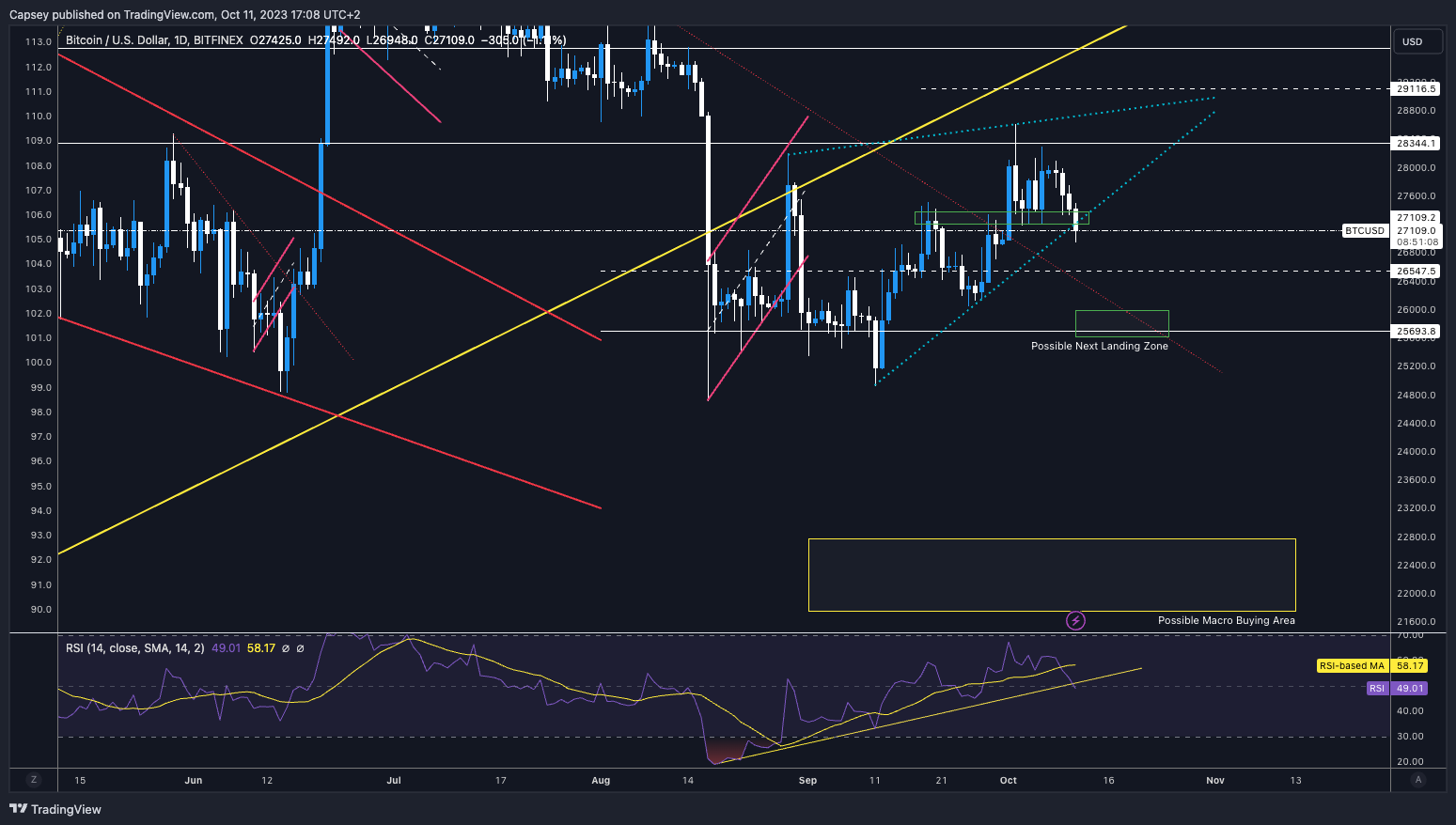
The geopolitical situation seems to be ramping up daily, which is likely why investors do not have a high conviction in markets, particularly in risk assets and, even more particularly, in Bitcoin. This is perhaps why we continue to see Bitcoin trade lower even though the S&P has traded higher over the past 4-5 days.
Bitcoin is currently between a key range of $27,100 to $28,300. $27,100 is a key horizontal support, and there is also the confluence of the local uptrend line. If Bitcoin closes daily candles convincingly below this level, then this opens the door to $25,900.
For now, while geopolitical tensions are extremely high, the situation is constantly changing, and Bitcoin remains in its range of $27,100 to $28,300 – leave it be. If the range breaks or there’s a meaningful change in the geopolitical situation, we will reassess and re-position trading-wise if needed. But for now, sit tight and let this come to you.
As always, thanks for reading.
Cryptonary, OUT!
Recommended from Cryptonary