Save 23% ($351) & Get a Free 1-1 Call with our Team ⏰ : 0d 2h 59m 44s

The first was the Quarterly Refunding Announcement from the Treasury, and the second was the Fed Meeting and Press Conference, where the Interest Rate was decided.
Now, we outlined the details of both in Monday's Market Updates, so please refer there for specific details.
But we will do a summarised version below, along with the result we've got for the QRA.
TLDR
- The Treasury is signalling more debt issuance ahead, pointing to a potential liquidity squeeze in coming months as excess reserves decline.
- However, the Treasury has stated they will also start buybacks, a positive development that could delay a liquidity crunch.
- In their latest statements, the Fed remained more hawkish than expected, not dovish as some had hoped – showing they are still sceptical about persistent inflation.
- This macro uncertainty means risk assets like crypto will likely face continued selling pressure and volatility for a while longer.
- However, we believe the current stormy conditions will create an opportunity for long-term crypto investors to accumulate positions at a discount.
- As hard as markets may fall soon, the foundations are being laid for the next major crypto bull. We share our thoughts on how to position for profit.
Disclaimer: Not financial or investment advice. You are responsible for any capital-related decisions you make, and only you are accountable for the results. “One Glance” by Cryptonary sometimes uses the RR trading tool to help you quickly understand our analysis. They are not signals, and they are not financial advice.
The Quarterly Refunding Announcement from the Treasury
The quarterly refunding announcement is a significant event. In the last QRA, Yellen said that rather than issue loads of longer duration Bonds (with maturities between 10 and 30 years) like the Treasury usually does, they would issue most of the debt issuance in the front end of the curve, i.e. shorter duration Bonds - Bonds that mature in 1-12 months.What this did is it allowed the Treasury/government in the US to keep raising debt to pay their expenses, but it wasn't issuing a load of longer duration Bonds, where the demand to buy these Bonds around the world was lacking.
Why did the Treasury do this?
Well, with demand for longer duration Bonds lacking, the Treasury couldn't issue loads of these longer duration Bonds. The fact is they wouldn't be bought up, meaning the price of these Bonds would go lower. In turn, the Yield on longer-duration Bonds would soar, meaning mortgage rates, credit card rates, etc., all go meaningfully higher. This would be too much of a tightening on the economy, and hence, the Treasury tried to avoid this by issuing shorter-duration Bonds (known as Bills - maturity of less than 12 months). Hence, as a result, we saw a rally in risk assets - including our "magic internet money" Bitcoin.But, issuing shorter-term debt, i.e. Bills, has seen the RRP drain to $600b from $2.2t. The draining of the RRP is what's kept market liquidity so positive.
But what happens when it depletes to $0?
Result of QRA just released
The Treasury has just announced that Coupons (debt with maturity between 2-10 years) will be increased - as expected. The Treasury will also be starting buybacks in the next quarter, which is quite bullish and will help market liquidity.But, this is expected as the RRP drains to 0, which it should over the coming months. The draining of the RRP from $2.2t to $600b has kept liquidity very positive as it offsets the QT (running off of the Balance Sheet) from the Fed.
It will now be really interesting to see how liquidity conditions change once the RRP drains to 0 and no longer offsets QT, although this is likely really pushed out further now.
A Treasury buyback should help liquidity a bit as the RRP depletes to 0. And with less Bills being issued and more Coupons being issued, this takes some pressure off the RRP in the short-term, maybe dragging out the depletion of the RRP to 0 by longer.
Conclusion on the QRA
There is likely to be a liquidity crunch at some point, but it may be pushed out to May, maybe even June now.This is due to QT still happening. The reason is that the Fed is running down its Balance Sheet, but the running down of the RRP (look at this as excess reserves) has offset that impact.
Think about it.
The Fed ran down their Balance sheet by $65-$80b/month - liquidity withdrawal. But, the RRP drains by $100b-$120b/month, leaving you with a $40-$60b net increase in liquidity. Now, that RRP is at $600b, having previously been at $2.2trillion - a $1.6trillion inflow to markets.
The draining of the RRP is now likely delayed and pushed out further. This puts pressure on liquidity with the Fed still running QT - the running off of $65-$80b/month of Fed assets.
Overall, the above is bad for asset prices, with so much debt issuance needing to be bought up. Although pressure has been taken off the RRP somewhat as fewer Bills issued slows the RRP's depletion. This liquidity issue in the coming months may be what brings the markets lower.
Now, the post-FMOC update
Let's dive into yesterday's FOMC, how the comments potentially change things, and what this then means for risk assets and crypto going forward.Firstly, the Fed decided to keep rates unchanged - completely expected.
The market was looking for Powell in the press conference to guide the first possible interest rate cut for the Fed March meeting.
However, he did not do this. In fact, he pushed back on it and actually suggested that a March rate cut is unlikely. Even when Powell was given low-ball questions where he could have taken a dovish tone, he chose not to and pushed back with a hawkish stance.
Powell mentioned several times that he and the Fed are looking for more supporting data that inflation is coming down, not one single data point, just more "good data". This gave the impression that the Fed is still sceptical about inflation here and will hold rates higher for longer than expected.
A word or two on inflation
A lot of the falling inflation has been due to goods inflation coming down. However, with the Houti situation in the Red Sea, goods inflation will likely spike up again in the coming months/quarters, providing a headwind for further falling inflation. Powell is likely anticipating this and is, therefore, holding higher rates for longer.And remember, if Powell starts cutting rates and inflation rears up again, the markets would react terribly if he had to begin raising rates again. This would likely be the worst outcome hence, Powell would rather stay higher for longer with rates.
Following this, the market was pricing in a 60% chance that the Fed would begin cutting rates in March, that's now fallen to just 30%. Remember, the economy and the labour market have been strong/far more resilient than what economists expected.
This gives Powell more room to keep rates high and allow QT to continue while the Treasury continues to issue large amounts of debt to fund their fiscal responsibilities (Government spending).
One side note is that the Fed removed the line "the US Banking system is sound and resilient" from the statement. This is very odd. Did they lie originally when they said it was strong, or are they genuinely worried about the Banking system now and have, therefore, removed that line?
Either way, it's peculiar and makes us suspicious, particularly when we saw New York Community Bancorp - the regional Bank that bought Signature Bank deposits in the Spring of 2023, crash yesterday. This is definitely something to watch.
Mention of QT
We finally got to QT in the Press Conference, with the Fed not mentioning it in the statement.Powell said the Fed will discuss tapering off QT at the March meeting. This likely means we don't see tapering begin until at least Q3 of 2024, particularly with the Treasury yesterday announcing in their QRA that they're going to issue more Bills (shorter duration debt) than Coupons (mid-duration debt). This takes the pressure off the RRP and will likely help keep it at the $500b/$600b mark.
What does this all mean for crypto?
Simply put, are the macro developments that we highlighted above good or bad for crypto?Let's first work out risk assets.
With the market pricing in rates being higher for longer, this will send Bond Yields slightly higher, which puts pressure on risk assets.
Why buy stocks when you're getting a 4.0% risk-free return by buying a US government bond?
So, following Powell, we saw Bond Yields go slightly higher and the S&P and Nasdaq sell down.
This has particularly been emphasised by big moves down in the tech companies that have actually reported relatively positively over the past few days. However, we still have Apple and others to report today and tomorrow.
But, essentially, what this means is that risk assets may struggle and may pull back in the coming months. When we look at the on-chain data, it paints a similar picture for BTC.
Therefore, we feel more strongly now that the market will see more downside in the coming months and stagnate as a best-case scenario.
How are we playing this?
Currently, we are about 75% Spot and 25% USDT, but we are constantly adding USDT to build the USDT bag.For that 75% spot, we are not choosing to sell; we'll just keep holding.
The 25% USDT and the USDT we'll add to our pot and keep building up, we will look to put to work in the market over the coming months.
Our feeling, and this is just a feeling (so we can easily be wrong), is that March/April will be the time to start really putting this capital to work by building positions gradually (so over the period) but with aggressive USDT orders.
BTC
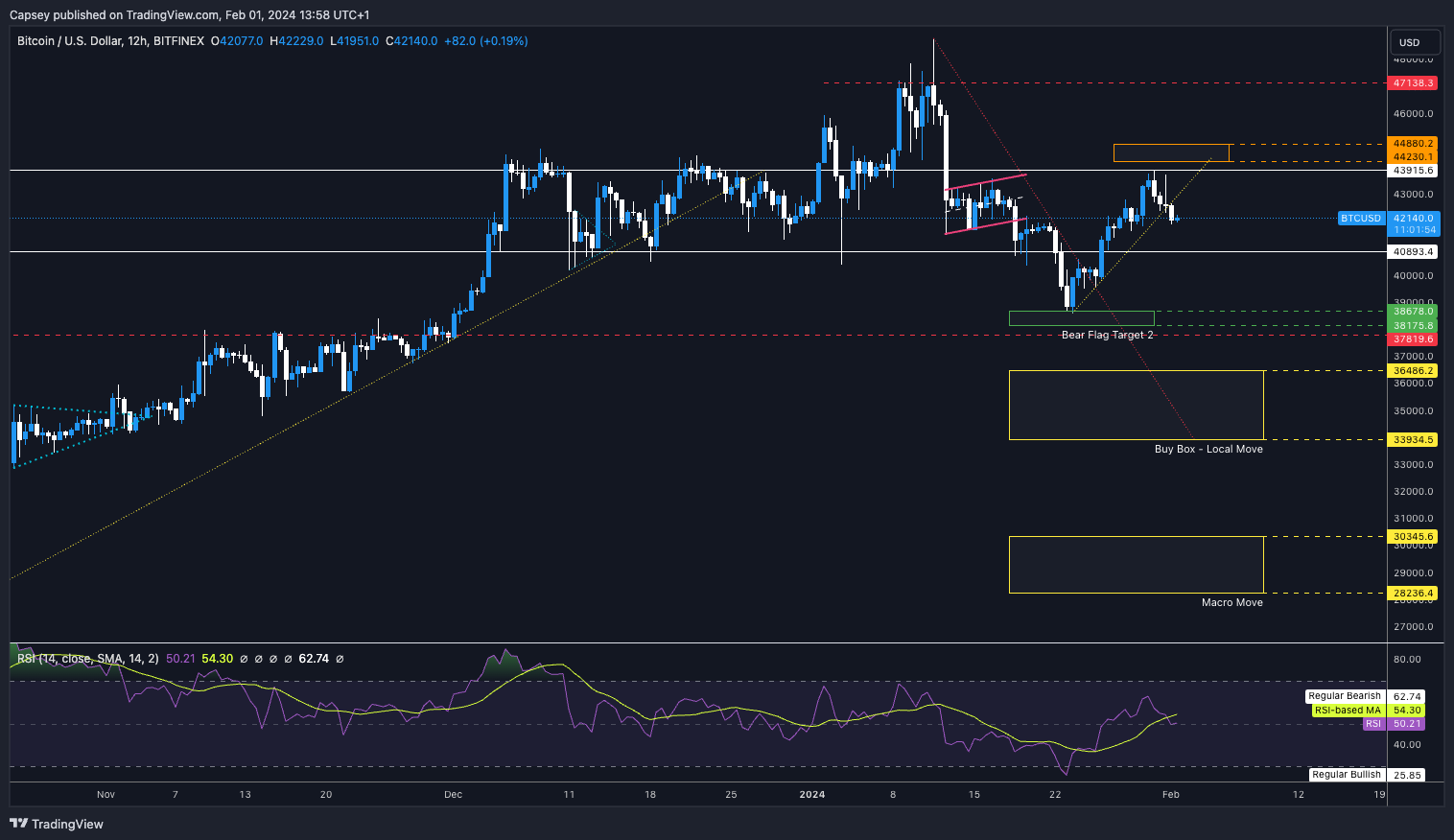
We will look to buy BTC in that upper yellow box, between $33,900 and $36,400.If we get price back here, long-term, we think it's an absolute gift.
ETH
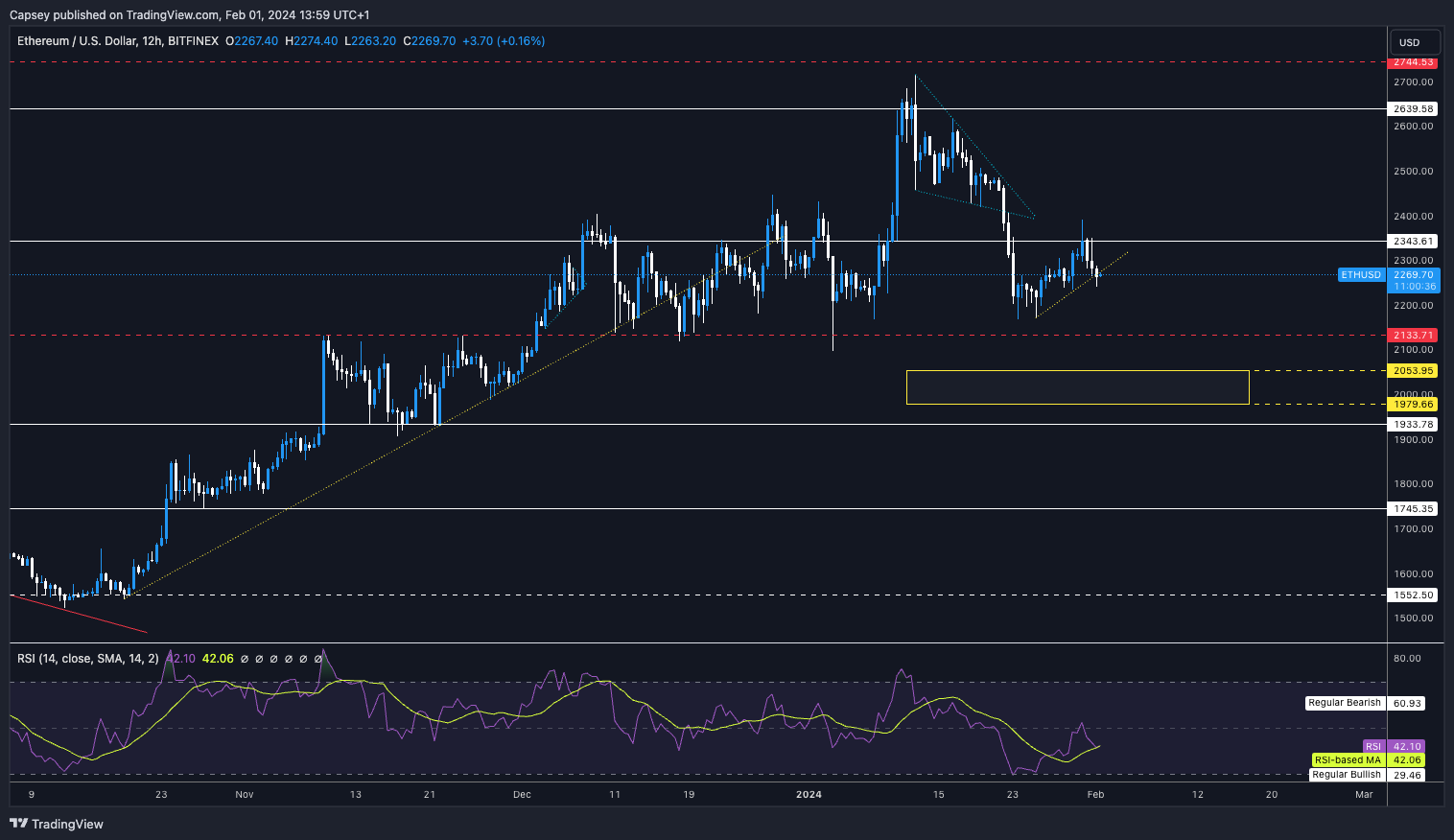
The yellow box would be the long-term buying range, between $1,979 and $2,053.We think price could even go slightly below that yellow box. If it did, we'd really build an aggressive position.
SOL
A little bit different. If price goes between $79-$86, we'll start adding to our bags.If price, goes into the low $70s and the $60s, we'll aggressively add.
And if price goes into the $50s we'll try and sell our kidneys to buy it - just joking, do not do this.
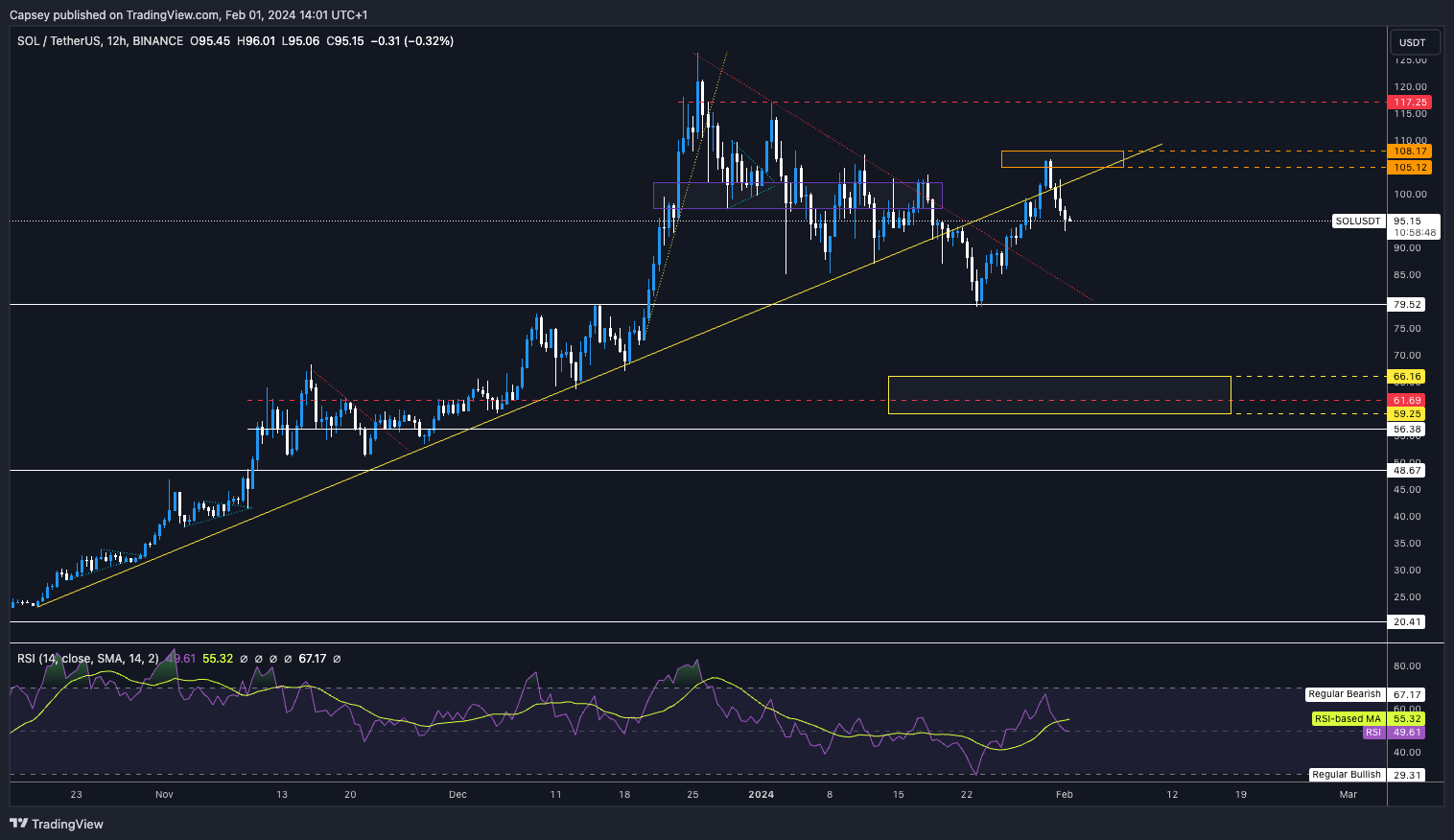
But, you see our stance on SOL in the $50s.
The update above covers the Fed meeting from yesterday, how we think the markets will now develop, and how we are looking to position and put capital to work over the coming months.
So far, we've been very good with charting and our overall market calls. A big, big few months are ahead of us.
This is the time to really size up on Spot bags in preparation for the real bull run.
The last few months have been a taster of far greater moves that will come in the coming quarters.
Cryptonary, OUT!
Recommended from Cryptonary