Save 23% ($351) & Get a Free 1-1 Call with our Team ⏰ : 0d 2h 59m 44s
Airdrops: 3 opportunities to farm in the coming months
Eclipse is a customizable Layer 2 rollup provider that works across multiple Layer-1 blockchains. It enables developers to deploy rollups using the Solana Virtual Machine (SVM) for fast execution while settling on Ethereum and using ETH for gas fees.
Disclaimer: This is not financial or investment advice. You are responsible for any capital-related decisions you make, and only you are accountable for the results.
Eclipse
Eclipse also integrates Celestia for scalable data storage and RISC Zero for efficient fraud proofs. The platform is designed to be scalable, cost-effective, and highly flexible for developers. They raised a total of $65 million from prominent venture capital firms.
To get the airdrop, we want to accumulate as much grass (points) as possible before the Token Generation Event (TGE)
Here is how to farm this airdrop:
TLDR
- Create Wallet
- Bridge to Eclipse Chain
- Register Turbo Tap account
- Complete boosts tasks
- Create swap volume
- Provide Liquidity
Detailed instructions
- STEP 1: The first thing we need to do is set up a wallet. Our recommendation is to use Backpack. You can get that here:
- STEP 2: Next, we need to actually move some funds over to Eclipse. The easiest option is to use Relay Bridge because it supports cross-chain and cross-asset transactions from both EVM networks and Solana.
- Here's how you do it:
- STEP 3: Turbo Tap is going to be our central hub for the points/grass dashboard. You'll need a code to join; use 9fFgPP, QhZcSp, 6kCApp
- STEP 4: The easiest way to farm grass is by simply holding ETH, SOL, USDC, or USDT in your wallet. The more size and the longer the duration these assets are held, the more points you will accumulate.
Here's how you do it:
- STEP 5 (OPTIONAL): Actually use the chain. At the time this article was published, there are currently 9 tasks we can complete in order to receive a boost. It is highly likely they will continue to add tasks over time. Each boost will grant a 10% passive grass increase. The easiest ones to complete are the following:
- Swap 10k volume on Lifinity:
- Earn 200 sauce on Let's Cook
- We also recommend providing liquidity on Invariant or Orca. Here's how:
- Step 6: Finally, the main NFT collection for Eclipse is the ASC (After School Club). There is a special role in their discord for owning one of these collections. It is also being used as a PFP by their Community Lead on Twitter:
Closing thoughts
Former airdrop criteria, such as Arbitrums, have consistently rewarded sustained activity and engagement, while projects like zkSync and Scroll have focused more on liquidity provision and TVL contributions. Based on these trends, we anticipate that Eclipse will adopt a hybrid model, making it crucial to cover all aspects of participation.Airdrops remain one of the most lucrative opportunities in crypto, providing passive ROI on assets that would otherwise remain idle. If you're not actively positioning yourself for them, you're essentially passing up free money.
The biggest mistake most people make in airdrop hunting is quitting too soon. Not every drop will result in a massive payday, but the few that do can more than make up for the ones that don't.
We see Eclipse as a high-upside opportunity, one with the potential for asymmetric returns. Those who move early and stay committed will be in the best position to benefit.
2 airdrops one shot: Paradex+Backpack
Paradex is a crypto derivatives exchange built on a StarkNet appchain, designed to optimize user experience with deep liquidity, low fees, and fast performance. It focuses on self-custodial, on-chain risk management for derivatives trading, addressing gaps in market trust, and risk assessment in the crypto exchange landscape. Paradex currently offers perpetual futures trading and aims to expand its asset offerings.The platform is tokenless and backed by some of the strongest VCs in the industry, such as Jump Capital, Dragonfly Capital, Paradigm, etc.
Farming perpetual future exchanges carries significant risk, but with high risk comes the potential for high rewards.
For example, the Hyperliquid airdrop, which was shared back in February 2024, took place on November 29, 2024. It distributed 310 million HYPE tokens to eligible users, accounting for 31% of the total supply. Valued at over $4.3 billion, this was one of the largest airdrops in crypto history, highlighting the massive potential rewards for active participants.
However, trading futures is notoriously difficult, with studies showing that 95% of traders fail, and only 1% of day traders remain consistently profitable after fees. Unless you are highly confident in your trading skills, we strongly recommend employing a delta-neutral strategy to farm these protocols simultaneously while minimizing directional market risk.
We will go over exactly how to do this later in the article.
According to Paradex's Docs, the current points program will run until July 2025 and conclude with a TGE shortly thereafter.

Our objective here is to accumulate as many points as possible. The points will later convert to tokens. The Paradex team has indicated the exact formula is intentionally opaque and meant to incentivize real trading activity. However, they did offer some guidance on how XP could be earned by participating in any of the following activities:
According to this Tweet from the Paradex account, 20% of the Genesis Allocation will be allocated toward Community Airdrop. That is very solid, to be fair.
So, how do we farm this airdrop?
In short:
- Bridge funds
- Trade
Detailed instructions
- STEP 1: The first thing we need to do is send funds to the Paradex exchange in order to trade. We will need to send USDC. There are a couple of different ways to do this, but we recommend using LayerSwap. This is how you do it:
- STEP 2: Setting Up the Trade - As discussed earlier, our approach to farming Paradex and Backpack will utilize a delta-neutral strategy to effectively neutralize any losses while actively using both platforms.
How it works:
- Simultaneous Opposing Trades → Open a long position on one exchange and a short position on the other with equal capital.
- Any price movement cancels out.
- P&L from one trade offsets the other.
- If you've done everything correctly, there should only be a price difference of a few dollars. We recommend practising with smaller amounts until you are comfortable with how everything works.
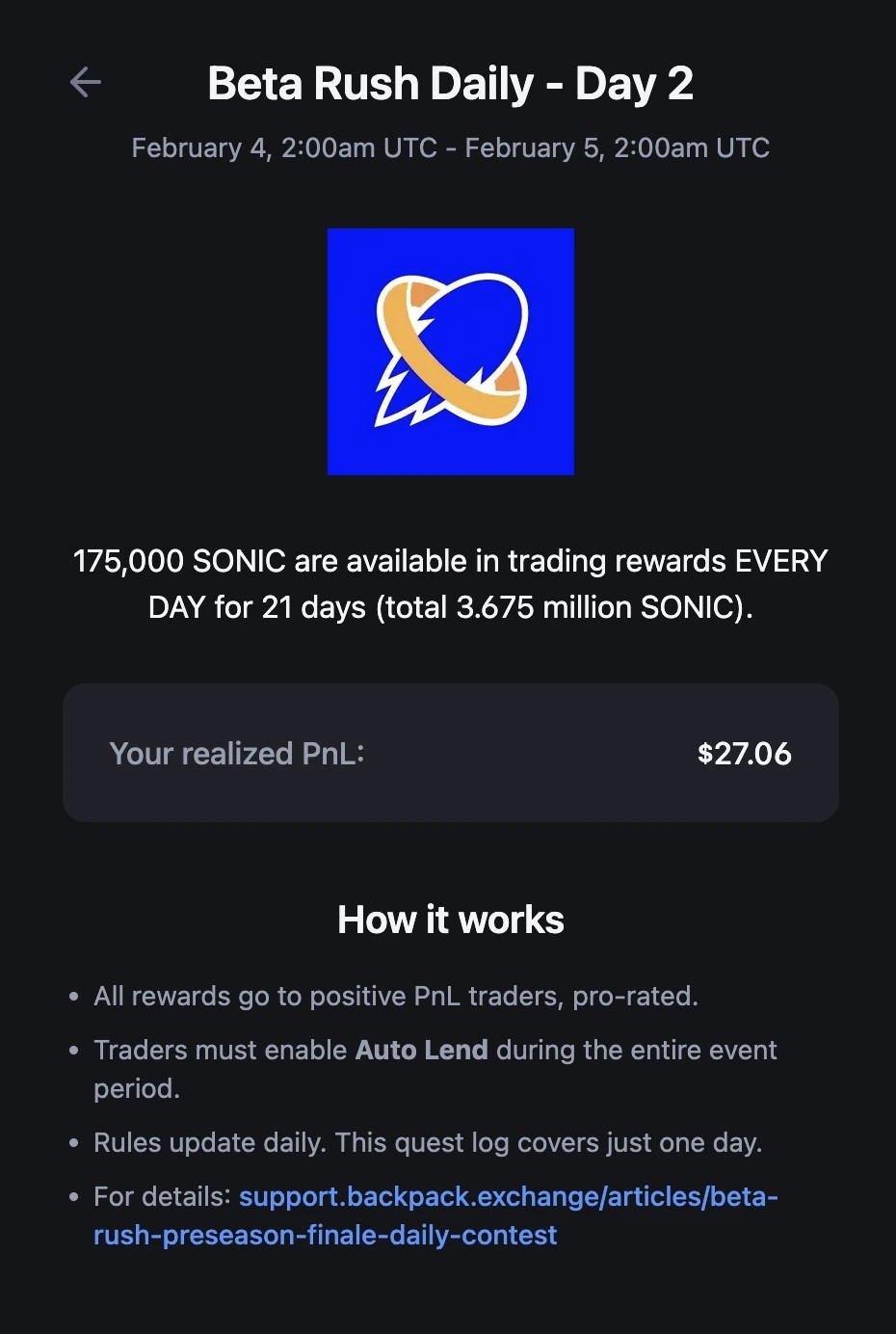
When implementing the delta-neutral strategy, our focus should be on capturing the positive PNL portion of the trade on Backpack, as it will actually end up generating profits through Sonic rewards.
These earnings can also help cover any small fees or losses incurred when opening the trades. We should also focus on trading the BTC pair because it has more liquidity, reducing slippage and fees when opening the trade.
Backpack
Backpack is a cryptocurrency exchange and multi-chain wallet that emphasizes self-custody, employing multiparty computation techniques to enhance fund security. Developed by Coral on the Solana blockchain, Backpack also serves as a wallet specifically designed for executable non-fungible tokens (xNFTs).
Unfortunately, due to ongoing regulatory uncertainty in many parts of the world, Backpack Exchange currently requires KYC (Know Your Customer) verification. We are hopeful that this may change under the current Trump administration. You can check if your country is inadmissible here:
In the meantime, you can still implement the delta-neutral strategy on other perpetual exchanges offering airdrop programs. If you prefer to avoid KYC, we recommend considering one of the following alternatives: Avantis, Reya, Perennial or SynQuote.
For the next 3 weeks, Backpack will be running the following incentive program before the start of the first official season.
After creating your account on Backpack, you will be able to deposit both Solana and Ethereum assets. While you can use various assets as collateral for trading, we recommend depositing USDC or USDT for simplicity. You can send the USDC or USDT to your Backpack Solana address like any other normal transfer. Always test with a small amount first.
BONUS/NOT NECESSARY
Backpack Exchange maintains a strong connection with the Mad Lads NFT collection. Owning one grants you a substantial discount on trading fees. As the leading blue-chip collection on Solana, many other projects have dedicated portions of their airdrops to this community. The most notable was Wormhole, which had an estimated value exceeding $10,000.
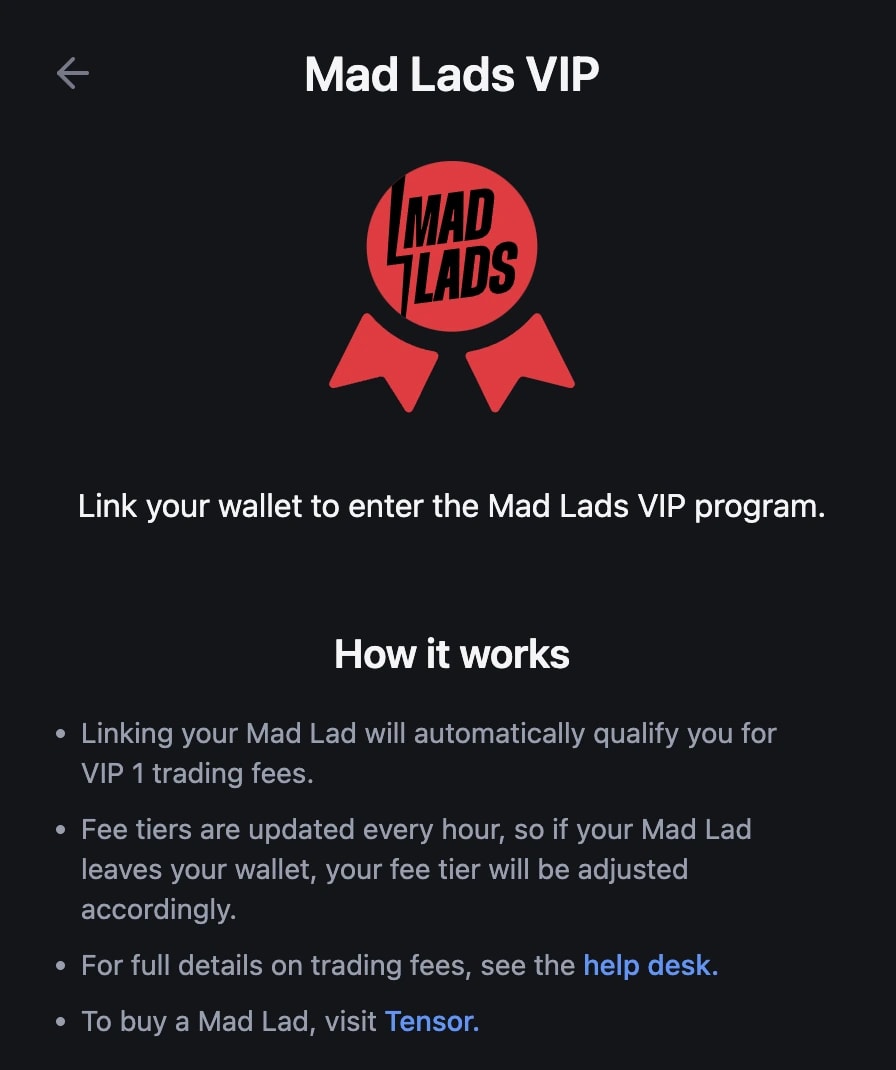
This is highly speculative and only recommended if you have extra capital and high conviction. The current floor price is 50 SOL and 9,968 supply. You can purchase one here:
Closing thoughts
To qualify for the Backpack and Paradex airdrops, active engagement in both perpetual and spot trading (only available on Backpack for now) will likely be the key factor. While the exact criteria remain undisclosed, history suggests that higher trading volumes and possibly holding spot assets will play a role in determining eligibility. By farming both protocols simultaneously, you're not only increasing your chances of receiving rewards but also optimizing your trading activity across two platforms.What sets our approach apart is the delta-neutral strategy, which allows us to maximize trading volume while effectively minimising risk. By opening equal long and short positions across Backpack and Paradex, we neutralize potential losses while maintaining the necessary activity to farm both airdrops. This strategy ensures that you're not just participating but doing so in a way that is both efficient and sustainable.
In the end, the key to a successful airdrop farm is consistency. Stay active, trade smart, and leverage strategies that maximize your rewards while minimizing exposure. With the right approach, you're positioning yourself to capitalize on both the Backpack and Paradex airdrops without taking unnecessary risks.
Happy farming!
Peace!
Cryptonary, OUT
Recommended from Cryptonary