Save 23% ($351) & Get a Free 1-1 Call with our Team ⏰ : 0d 2h 59m 43s
Deep Dive: Why a TradFi Giant Is Quietly Accumulating This Token
Crypto markets remain dominated by uncertainty, but institutional behaviour is beginning to diverge from retail sentiment. While price action reflects caution, capital allocation decisions suggest a longer-term thesis forming around the infrastructure layer of on-chain finance. Let’s dive in…
TLDR
- Institutions are quietly accumulating DeFi governance tokens
- Unlike past cycles, this is secondary-market buying after large drawdowns,
- However, DeFi’s equity + token structure still limits clear value accrual, keeping the investment case incomplete
- Institutional interest is constructive long term, but sustained upside likely depends on Bitcoin forming a market bottom first.
Disclaimer: This is not financial or investment advice. You are responsible for any capital-related decisions you make, and only you are accountable for the results.
What happened?
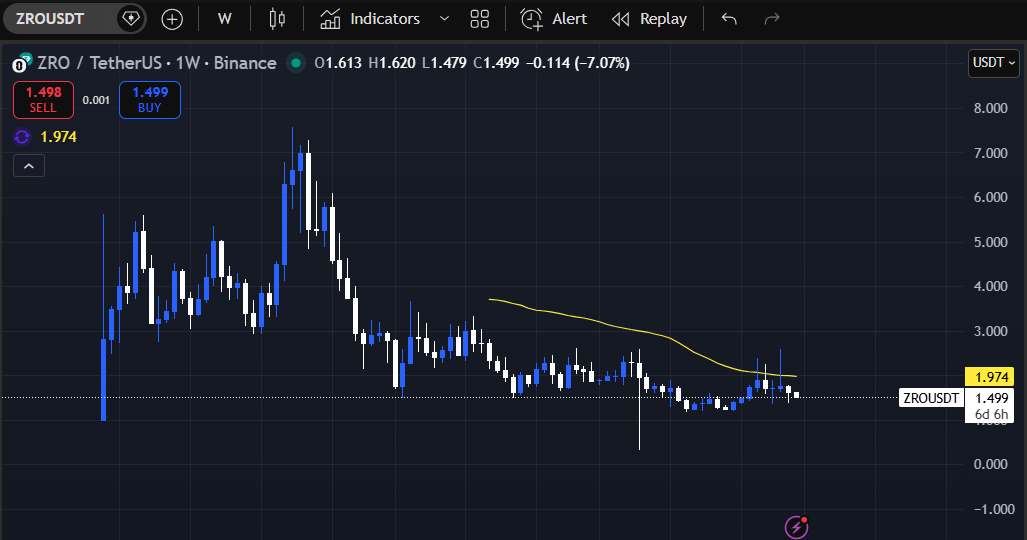
While the price action is sucking all hope from market participants, the biggest institutions around the world are making their moves amidst intense fear across the crypto market.Citadel Securities (one of the world's largest market makers) disclosed a strategic investment in $ZRO (LayerZero's native token) around two weeks ago. This came as part of LayerZero announcing Zero, their new high-performance Layer 1 blockchain (2m TPS 👀) built explicitly for institutional-grade financial markets.
The price has climbed over 24% in 24 hours following an announcement that major institutional players, including Citadel Securities, are backing the new "Zero" blockchain.
A quick primer to LayerZero: it was originally built as an interoperability protocol, not a traditional L1. Its core innovation is enabling omnichain communication, allowing applications to operate seamlessly across multiple blockchains without relying on wrapped assets, centralised bridges, or fragmented liquidity pools.
Instead of competing as “another chain,” LayerZero positioned itself as connective infrastructure:
- Messaging layer between chains rather than a settlement layer
- Designed to reduce bridge risk (historically one of crypto’s largest attack surfaces)
- Enables unified liquidity and cross-chain composability for applications
- The launch of Zero signals a strategic evolution from interoperability middleware to high-frequency and regulated institutional infrastructure.
Very exciting development, however…
We’ve Seen This Movie Before
Crypto history is cyclical when it comes to “next-gen” Layer-1 narratives. Every cycle introduces a technically sophisticated chain promising orders-of-magnitude improvements in throughput, latency, and developer experience.Recent examples include:
- Aptos → Parallel execution + Move language pedigree from ex-Meta engineers
- Sui → Object-centric model aiming for sub-second finality
- Sei → Purpose-built for trading with high-performance matching assumptions
- MegaETH → Real-time execution narrative pushing ultra-low latency design
It’s hard to convince market participants simply by higher TPS or lower latency. The market wants to see adoption and apps with great UI/UX.
Where this case does diverge from prior L1 fundraising patterns is capital timing. Historically:
- VCs allocated at extreme discounts pre-launch.
- Tokens were distributed via TGE.
- Early investors dumped on retail liquidity during narrative hype.
In the case of ZRO, though, institutions are buying the token after 1.5 years post TGE, while the token is down around 80% from its all-time highs. This is secondary-market accumulation, while VC plague we are accustomed to buy in a way before tokens were live.
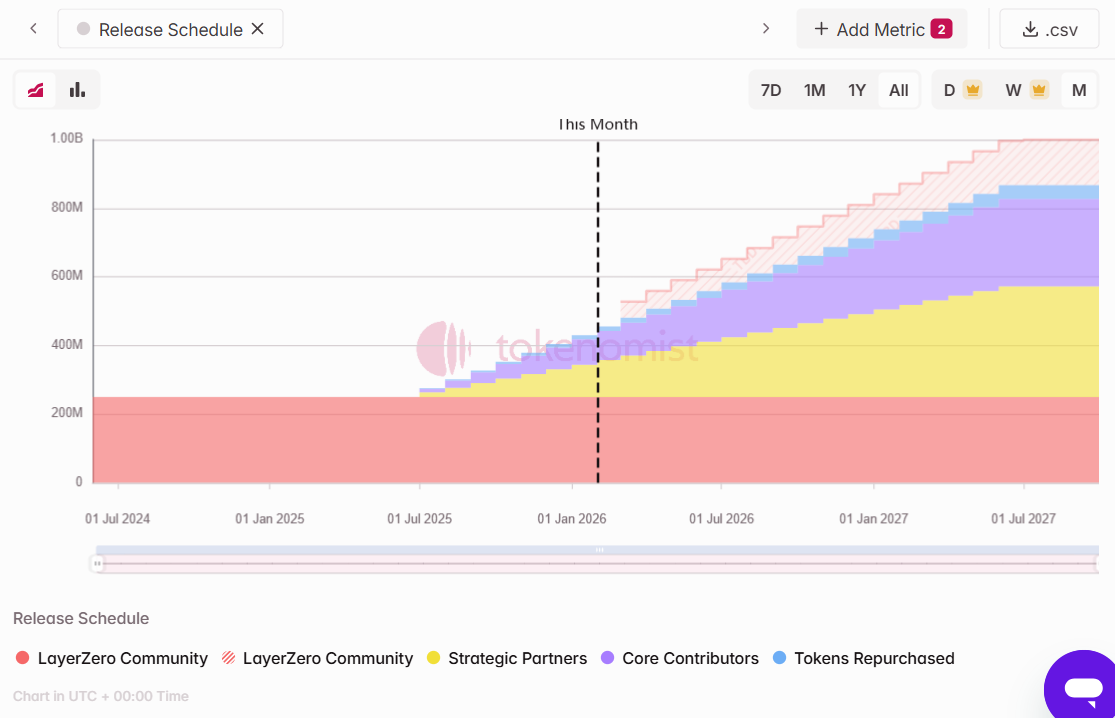
That’s what makes this development particularly interesting. For the first time, large institutions are directly allocating capital to DeFi tokens tied to live, functioning products.
For context, ZRO is primarily a governance and staking token, with limited direct value accrual mechanisms today, as only Stargate-generated revenue is currently used for buybacks. Despite this, institutional participation suggests a longer-term view on governance tokens, likely anticipating future changes that could strengthen token-level value capture.
It is important to remember that governance tokens embed optionality. Even if value accrual is limited today, governance (voting) can later redirect protocol revenues toward buybacks, burns, or staking rewards. Institutional investors may therefore be positioning ahead of potential monetisation upgrades rather than reacting to current token utility.
For example, the introduction of a new L1 can expand value accrual through transaction fees and burn mechanisms.
However, ZRO is not an isolated case of institutional interest. Similar flows are emerging across other DeFi governance tokens.
Other DeFi Tokens Are Being Bid As Well
BlackRock disclosed exposure to UNI, while Apollo revealed an allocation to Morpho. Notably, Apollo entered an agreement to acquire up to 90 million MORPHO tokens, representing roughly 9% of the total supply.Institutional allocation to ZRO, UNI and MORPHO shows growing recognition of governance tokens as strategic assets tied to revenue-generating protocols. In general, this validates governance tokens as investments.
At the same time…
- Wall Street Is Tokenising Everything
- This token accumulation is happening alongside a broader institutional push into tokenisation.
- JPMorgan launched a tokenised money-market fund on Ethereum, signalling deeper on-chain finance integration.
- BNP Paribas also issued tokenised fund shares using Ethereum infrastructure.
- Analysts describe 2026 as a potential “inflection point” for digital assets’ role in global finance.
DeFi Needs Proper Structure
Everything seems to be aligning for the rebirth of DeFi and the formation of a new trend. However, for DeFi to achieve widespread investor adoption, the industry must evolve toward a clearer and more coherent investor framework. Today, most protocols operate under a hybrid equity + token structure that inherently misaligns incentives between stakeholders.In many cases, the protocol generates economic value on-chain, while the operating company or interface captures strategic and financial upside through traditional equity ownership.
Protocols such as Uniswap and Aave show this structural tension well: fees and activity accrue to the protocol layer, yet the entities building interfaces, expanding partnerships, and controlling development often benefit equity holders more directly. This raises an ongoing question: where should value ultimately accrue: the token or the company?
Token holders typically receive governance rights, but governance alone rarely translates into meaningful economic participation. Without clear value capture mechanisms, tokens risk functioning more like speculative assets rather than productive financial assets. As a result, teams naturally gravitate toward directing value to equity, which offers clearer legal protections, stronger control, and predictable monetisation pathways.
This creates several structural problems:
- Founders and early teams primarily benefit from equity appreciation.
- Token holders face dilution through emissions and incentive programs.
- Liquidity often becomes mercenary, leaving once rewards decline.
- Governance participation remains low, weakening tokenholder influence.
- Equity holders don’t prioritise the token, while tokenholders don’t accrue any value
When both instruments coexist, it becomes extremely hard to align incentives. Equity holders would want to direct value towards equity, while tokenholders want the token to capture all the value. Asa result, this creates tension and misaligned incentives.
It is interesting to note that while Citadel invested in the ZRO token directly, ARK Invest invested in equity, which doesn’t benefit tokenholders. The long-term solution is converging these structures. Ideally, the token itself would function as a form of programmable equity, aligning incentives across tokenholders, teams, foundations, and external investors within a single economic layer.
In such a model, governance rights, cash flows, and ownership would no longer be fragmented between parallel systems, and make DeFi tokens great again…
Cryptonary’s Take
Taken together, allocations to ZRO, UNI, and MORPHO point toward a growing institutional thesis: as financial activity gradually moves on-chain, ownership of the protocols coordinating liquidity, lending, and interoperability may become more valuable than exposure to individual applications themselves.So, Cryptonary, will DeFi tokens now go up? Is that a new meta?
Not necessarily, at least not yet.
Institutional interest in governance tokens is undeniably constructive. However, the current equity + token structure across much of DeFi still makes it difficult to form a fully conviction-driven investment thesis. When value accrual remains split between equity holders and token holders, incentives stay fragmented, limiting the clarity institutions typically require before allocating at scale.
More importantly, crypto remains a reflexive market dominated by Bitcoin’s trend. Almost nothing in the asset class sustains a prolonged uptrend while Bitcoin itself is trending lower. In other words, institutional positioning can signal where capital wants to be over the long term, but it does not override short-term market structure.
However, we are already making notes. Select DeFi assets are beginning to show early signs of renewed interest and relative strength beneath the surface.
For now, the key variable remains unchanged: we want to see Bitcoin establish a credible bottom before turning more aggressive on higher-beta sectors like DeFi.
Until then, patience remains a strategy.
Cryptonary’s OUT!
Continue reading by joining Cryptonary Pro
$1,548 $1,197/year
Get everything you need to actively manage your portfolio and stay ahead. Ideal for investors seeking regular guidance and access to tools that help make informed decisions.


For your security, all orders are processed on a secured server.
As a Cryptonary Pro subscriber, you also get:
3X Value Guarantee - If cumulative documented upside does not reach 300% during your 12-month membership, you can request a full refund. Terms
24/7 access to experts with 50+ years’ experience
All of our top token picks for 2025
On hand technical analysis on any token of your choice
Weekly livestreams & ask us anything with the team
Daily insights on Macro, Mechanics, and On-chain
Curated list of top upcoming airdrops (free money)
3X Value Guarantee
If cumulative documented upside does not reach 300% during your 12-month membership, you can request a full refund.

Our track record speaks for itself
With over 2.4M tokens and widespread misinformation in crypto, we cut through the noise and consistently find winning assets.
Our track record speaks for itself
With over 2.4M tokens and widespread misinformation in crypto, we cut
through the noise and consistently find winning assets.


Frequently Asked Questions
Can I trust Cryptonary's calls?
Yes. We've consistently identified winners across multiple cycles. Bitcoin under $1,000, Ethereum under $70, Solana under $10, WIF from $0.003 to $5, PopCat from $0.004 to $2, SPX blasting past $1.70, and our latest pick has already 200X'd since June 2025. Everything is timestamped and public record.
Do I need to be an experienced trader or investor to benefit?
No. When we founded Cryptonary in 2017 the market was new to everyone. We intentionally created content that was easy to understand and actionable. That foundational principle is the crux of Cryptonary. Taking complex ideas and opportunities and presenting them in a way a 10 year old could understand.
What makes Cryptonary different from free crypto content on YouTube or Twitter?
Signal vs noise. We filter out 99.9% of garbage projects, provide data backed analysis, and have a proven track record of finding winners. Not to mention since Cryptonary's inception in 2017 we have never taken investment, sponsorship or partnership. Compare this to pretty much everyone else, no track record, and a long list of partnerships that cloud judgements.
Why is there no trial or refund policy?
We share highly sensitive, time-critical research. Once it's out, it can't be "returned." That's why membership is annual only. Crypto success takes time and commitment. If someone is not willing to invest 12 months into their future, there is no place for them at Cryptonary.
Do I get direct access to the Cryptonary team?
Yes. You will have 24/7 to the team that bought you BTC at $1,000, ETH at $70, and SOL at $10. Through our community chats, live Q&As, and member only channels, you can ask questions and interact directly with the team. Our team has over 50 years of combined experience which you can tap into every single day.
How often is content updated?
Daily. We provide real-time updates, weekly reports, emergency alerts, and live Q&As when the markets move fast. In crypto, the market moves fast, in Cryptonary, we move faster.
How does the 3X Value Guarantee work?
We stand behind the value of our research. If the documented upside from our published research during your 12-month membership does not exceed three times (3X) the annual subscription cost, you can request a full refund. Historical context: In every completed market cycle since 2017, cumulative documented upside has exceeded 10X this threshold.
TermsRecommended from Cryptonary