Save 23% ($351) & Get a Free 1-1 Call with our Team ⏰ : 0d 2h 59m 43s
Central banks remain cautious amid escalating Middle East tensions, but risk assets are defying gravity. The Fed's Wednesday meeting looms with rates expected unchanged, whilst BTC holds firm above $100k despite regional conflicts. This disconnect between geopolitical risk and market performance suggests either remarkable resilience or dangerous complacency—and the next move could determine which narrative proves correct.
TLDR
- Fed steady: Rates likely unchanged; 2 cuts still expected in 2025
- Markets calm: Geopolitical tension, but equities and oil hold steady
- Crypto strong: BTC > $100K; ETF inflows support price
- Strategy: Buying BTC, ETH, SOL, HYPE on dips
Topics covered
• Wednesday's Fed Meeting • Escalating Tensions Between Iran and Israel • Diving Into BTC and TOTAL3 • Cryptonary's TakeDisclaimer: This is not financial or investment advice. You are responsible for any capital-related decisions you make, and only you are accountable for the results.
Wednesday's Fed meeting
At this Wednesday's Fed Meeting, the Fed will decide whether it should change Interest Rates. Additionally, they will release an updated Dot Plot (projections for the path of interest rates over the coming years). The expectation is for Interest Rates to remain unchanged, with the market pricing close to 100% that the Fed won't change the rate. The market is currently pricing the September Fed Meeting as a coin toss for the first Interest Rate cut (just shy of a 50% chance at the September Meeting).What we know is that the Fed have somewhat committed to being late to the Interest Rate cutting table. The reason for this, and they have stated this, is that they want to see the follow-through effect of the tariffs, and how inflationary or not the tariffs might be. This naturally puts the Fed on hold (not adjusting Interest rates) for more months, even though we're beginning to see a slowdown in the labour market, as seen in recent data.
At Wednesday's Fed Meeting, the Fed will also release an updated Summary of Economic Projections and an updated Dot Plot. The expectation is that they may up inflation for 2025 very slightly, whilst bringing it down slightly in 2026. The Dot Plot will therefore likely still show two Interest Rate cuts for 2025, followed by more in 2026.
Escalating tensions between Iran and Israel
Firstly, this is a rapidly developing conflict, which seems to be escalating hour by hour. But to summarise the last few days, we can say that both sides have launched missiles at each other, with some Iranian missiles striking targets (some civilian), whilst Israeli missiles have mainly targeted senior officials, nuclear sites, and military locations.The rumours overnight are that the Iranians have reached out to the US and Trump in the hopes of re-negotiating a peace deal, having previously had 60 days to do so, but failed to reach an agreement. This came after the Israelis disabled multiple Iranian anti-air systems, giving them clearer skies to take out targets.
Many are questioning: What is Israel’s true goal here? Is it to delay Iran’s nuclear programme by years (by eliminating key scientists and infrastructure), even though Fordow — a critical facility — is unreachable without US bunker-buster bombs? Or is it to trigger regime change by removing senior officials loyal to Ayatollah Khamenei? Or perhaps both? For now, it's unclear. But what is clear is that the US and Trump do not currently want to get directly involved, and Israel retains the military advantage.
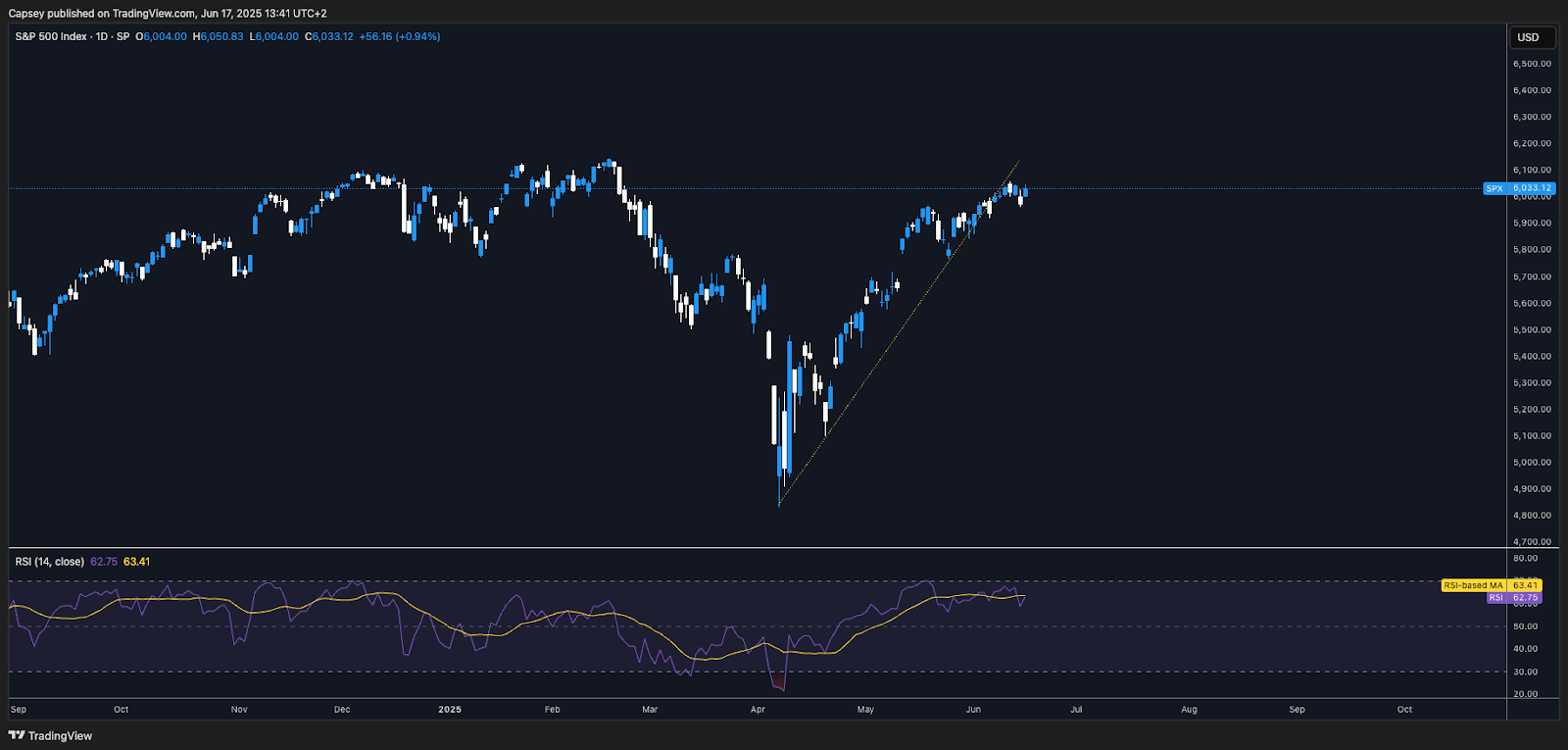
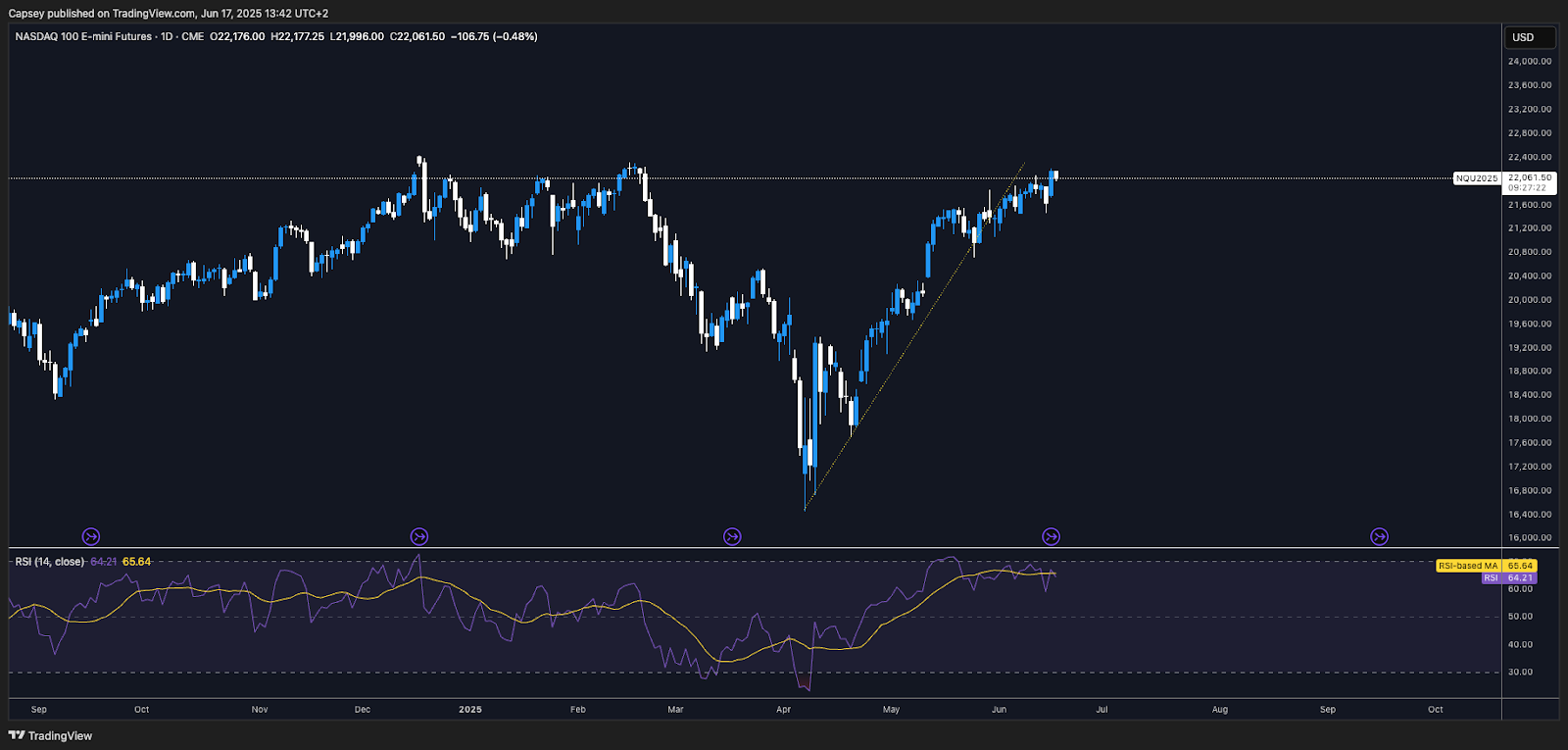
The above absolutely represents a risk to markets, but for now, they're taking it in their stride. However, markets might drop more significantly should something more severe and unexpected happen. This might be one of the following:
- A nuclear weapon is dropped
- The Iranians close the Strait of Hormuz (this would severely disrupt supply chains for oil, causing a large price spike and involving major global powers)
- Khamenei or Netanyahu are killed (far greater chances of Khamenei being killed than Netanyahu)
S&P500 1D timeframe:
Nasdaq 1D timeframe:
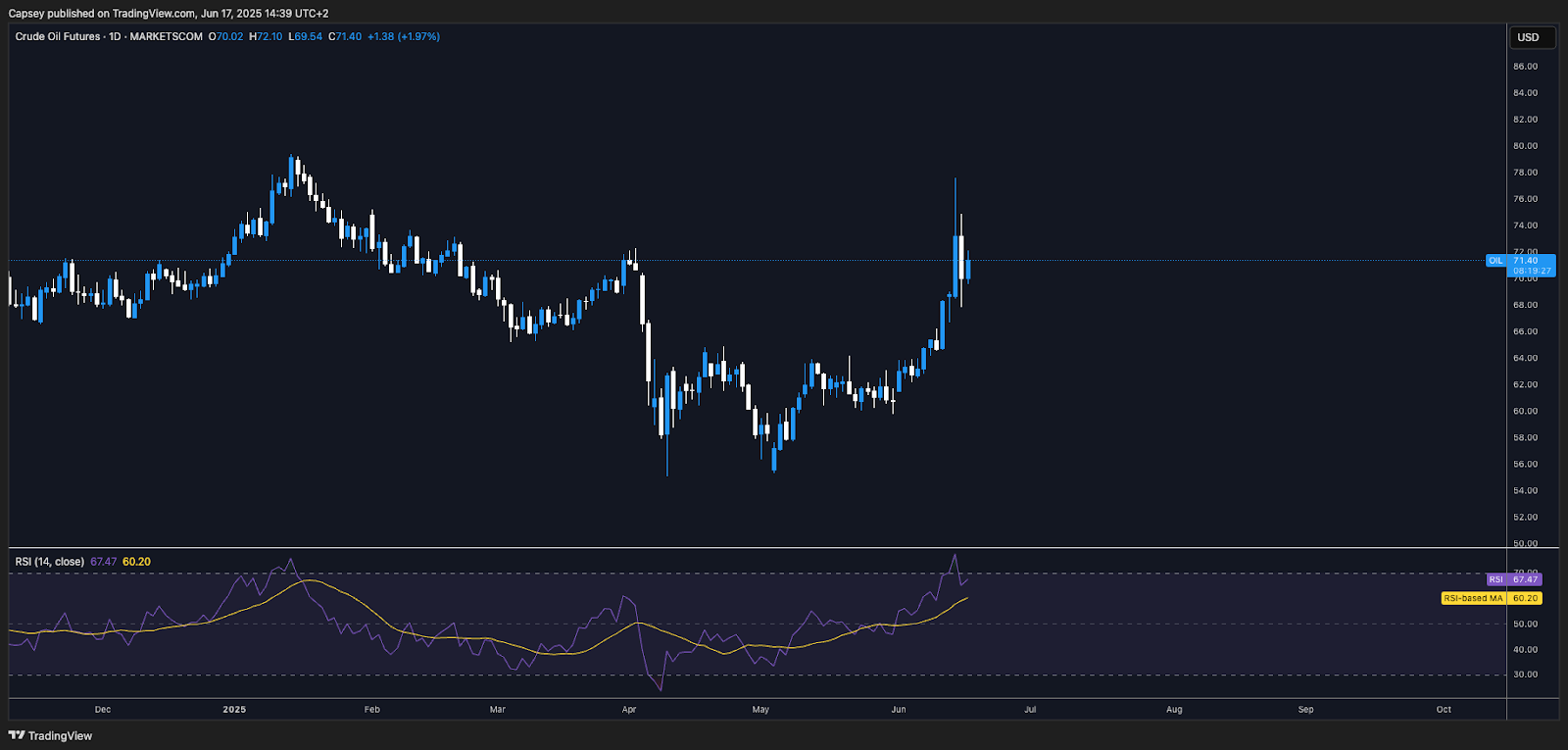
Alongside this, Oil is perhaps telling us that the event is already well priced, and the move up has already played out. If there are de-escalations or just a swift ending to this war, then it's very possible that Oil returns down to the $60 level. For now, Oil remains elevated whilst tensions remain high, and should a more unexpected event take place, we would then expect Oil to move higher. But for now, this isn't our base case.
Oil 1D timeframe:
Diving into BTC and TOTAL3
As we mentioned above, BTC and risk assets in general have held up well over the last week, despite the escalation in the Middle East. BTC has been supported by meaningfully positive ETF flows, which have enabled the price to remain above $100,000, fluctuating between $102,500 and $110,500, just shy of all-time highs.BTC ETF's Inflows:

Another indicator we look to is TOTAL3 (total crypto market cap excluding BTC and ETH). This indicator gives us a clearer picture as to whether we're moving into more of an 'Alt season' environment, or not. For us, that key level (indicating a shift to a risk-on market) was TOTAL3 attempting to breakout above $880b. Price briefly broke out, but we saw this indicator pull back upon Middle East escalations.
However, price has returned to the top of its support range between $807b and $830b, whilst BTC is just a 5% move away from its all-time highs. This doesn't look too bad to us, and we do expect it to begin its path higher again once some of the geopolitical uncertainty decreases.
TOTAL3 1D timeframe:

Cryptonary's take
In the short-term, risk assets have held up well under the weight of a significant conflict in the Middle East that does risk embroiling other nations. But for now, it seems somewhat contained, and that's potentially why risk assets are looking through it.Our base case is that this conflict can continue for more weeks, but that we may be at or very close to peak tension with it. If we continue to see volatility over the coming weeks (and we expect we will do), we will use it as an opportunity to accumulate Spot bags for the longer-term — with a view to holding positions for 12–18 months, going into and out the other side of an Interest Rate cutting cycle that likely ends in late 2026.
We therefore continue to be buyers of Majors:
- BTC: between $95k and up to $102k
- ETH: between $2,160 and $2,420
- SOL: between $110 and $150
- HYPE: between $24 and $32
We remain patient and confident in the process of building positions over the summer.
Recommended from Cryptonary